The Vast Sambor Prei Kuk
The Vast Sambor Prei Kuk
Former capital of the Chenla kingdom in the 7th century, Sambor Prei Kuk brings together more than a hundred brick sanctuaries north of Kampong Thom, listed as a UNESCO World Heritage site since 2017.
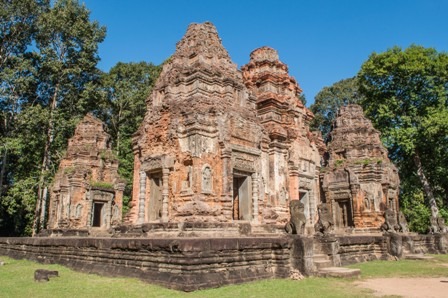
Sambor Prei Kuk is a collection of pre-Angkorian temples located approximately 30 km north of Kampong Thom and 150 km southeast of Angkor. The site corresponds to the former capital of the Chenla kingdom, Ishanapura, founded in the 7th century. Inscribed as a UNESCO World Heritage site in 2017, it encompasses more than a hundred brick sanctuaries scattered throughout the forest.
Why Visit Sambor Prei Kuk
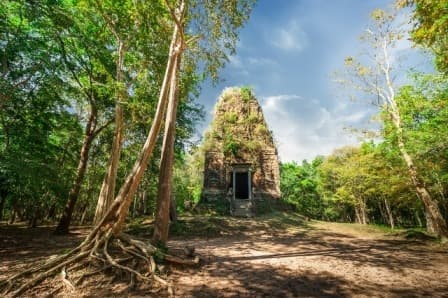
The site offers rare testimony to Khmer architecture predating Angkor, with techniques and decorative vocabulary that herald the great complexes of the 9th to 13th centuries. Visitor numbers remain moderate compared to Angkor, making for a more tranquil experience. The forest setting, traversed by massive roots encroaching upon the brickwork, lends the place a distinctive atmosphere, reminiscent of Ta Prohm but on a more intimate scale.
- A UNESCO site still relatively undiscovered
- A logical stopover between Phnom Penh and Siem Reap
- A historical complement to exploring Angkor (prefigures classical Khmer style)
History
Ishanapura was one of Southeast Asia's first centralized states. The Chenla kingdom was initially ruled by Citrasena Mahendravarman, the first identified sovereign. His son Isanavarman, who reigned between 616 and 637, commissioned the construction of the main temple, Prasat Sambor: an inscription found on site marks his reign in 627. King Jayavarman I would be the last ruler of the kingdom before its fragmentation.
The site subsequently fell into relative obscurity for centuries. In 1970, following Lon Nol's coup d'état against Prince Norodom Sihanouk, American bombing campaigns ordered by Richard Nixon in the context of regional conflict affected the area. Landmines were scattered across the terrain and were not fully cleared until 2008. Despite these destructions, the complex was inscribed as a UNESCO World Heritage site in 2017.
What to See on Site
The complex occupies the east bank of a waterway (the Stung Sen, a tributary of the Tonlé Sap) and is protected on three sides by a double system of ramparts and moats to the north, west, and south. Excavations have identified 52 small sanctuaries in good condition and 52 others buried, now forming discrete hillocks. The dominant materials are brick, sandstone, laterite, and limestone. The central section divides into three principal groups.
Prasat Sambor (Northern Group)
Eleven separate temples, surrounded by a two-walled rampart. The sanctuaries combine square and octagonal plans, with summits worked into lotus shapes in sandstone. The ensemble sits upon a rectangular platform 24 meters in height, covering approximately 25,200 m². This is the group associated with the reign of Isanavarman.
Prasat Tao – the Temple of Lions (Central Group)
Eighteen temples enclosed by a laterite wall 310 meters long, covering approximately 101,650 m². The group derives its name from seated lions flanking the stairways, mouths agape toward the entrance. A gopura marks each of the east and west entrances. Within the ramparts remains a rectangular pond measuring 42.10 m by 34.20 m, typically dry during the dry season.
Prasat Yeaye Peou (Southern Group)
Twenty-two octagonal-form sanctuaries within a rectangular enclosure bounded by a double rampart of brick, laterite, and sandstone. Upon the eastern gopura once stood a stele carved with 17 lines, now preserved in the Kampong Thom Provincial Museum.
Kroul Romeas and Surroundings
Set apart from the three principal groups, the Kroul Romeas complex comprises four brick sanctuaries built later, during the reign of Suryavarman I in the late 11th century. On the nearby mountain of Phnom Santuk, several Reclining Buddhas (Buddha entering Nirvana) have been carved directly into the rock, with the largest reaching some ten meters. One also finds the Preah Bat Chan Tuk, carved at the initiative of King Ang Chan I in the 16th century.
Religion and Inscriptions
The official religion of Ishanapura was Shaivism, one of the major branches of Hinduism, centered on the veneration of Shiva and the lingam. Numerous Sanskrit inscriptions, carved into stone, invoke both Hindu deities and local divinities. Altars bearing a lingam and its base (yoni) remain visible in several sanctuaries.
Practical Information
Visits are made on foot, from one temple group to another, along forest paths. Allow 2 to 3 hours to traverse the three principal ensembles, longer if you include Phnom Santuk. An entrance fee is collected upon arrival and it is possible to hire a local guide on site, recommended for deciphering inscriptions and iconography. The site is open daily during daylight hours.
- Sturdy closed-toe footwear (paths, roots, brickwork)
- Water, hat, insect repellent
- Stay on marked trails (legacy of demining operations)
When to Go
The dry season, from November to March, remains the most comfortable period: pleasant temperatures, passable trails, favorable light for photography beneath the trees. During the wet season (May to October), vegetation grows denser and the interplay of shadow in the forest takes on another dimension, though some paths may become muddy. The central group's pond is typically dry by late dry season.
How to Get There
The gateway is the city of Kampong Thom, accessible by bus from Phnom Penh or Siem Reap (approximately half a day's travel from either). From Kampong Thom, the site is reached in about thirty kilometers to the north, by private car, taxi, or tuk-tuk. Sambor Prei Kuk makes for a convenient stopover to break the journey between Phnom Penh and Angkor.
To See in the Region
Sambor Prei Kuk lends itself to a broader itinerary around the great Khmer and Cambodian sites:
- The Bayon Temple, at Angkor Thom, to compare pre-Angkorian with Khmer apogee
- The Terrace of Elephants, another component of Angkor Thom
- The coffee plantations of Mondulkiri, to extend eastward into the country
- The crab market of Kep, toward the southern coast
Frequently Asked Questions
Frequently asked questions
Yes. The site dates to the 7th century and belongs to the pre-Angkorian period of the Chenla kingdom. Angkor, as capital of the Khmer Empire, did not emerge until the 9th century. Sambor Prei Kuk is thus a stylistic precursor to the great temples that followed.
Allow 2 to 3 hours to traverse the three principal groups on foot. If you add Phnom Santuk and its carved Buddhas, plan a full day departing from Kampong Thom.
Yes. Demining operations were completed in 2008 and areas open to the public are secure. It is nonetheless recommended to remain on marked trails.
It is a common pairing. Sambor Prei Kuk lies approximately 150 km southeast of Angkor and constitutes a logical stopover on the route between Phnom Penh and Siem Reap.
It is not mandatory but is advised. A local guide helps identify inscriptions, represented divinities, and the chronology of the three groups, which are poorly marked on site.
Include Sambor Prei Kuk in Your Journey
To incorporate the site into a custom itinerary, between Phnom Penh, Kampong Thom, and Angkor, consult our Cambodge travel ideas and build a route suited to your pace.
Interested in this visit?
We can include it in your personalised itinerary.